
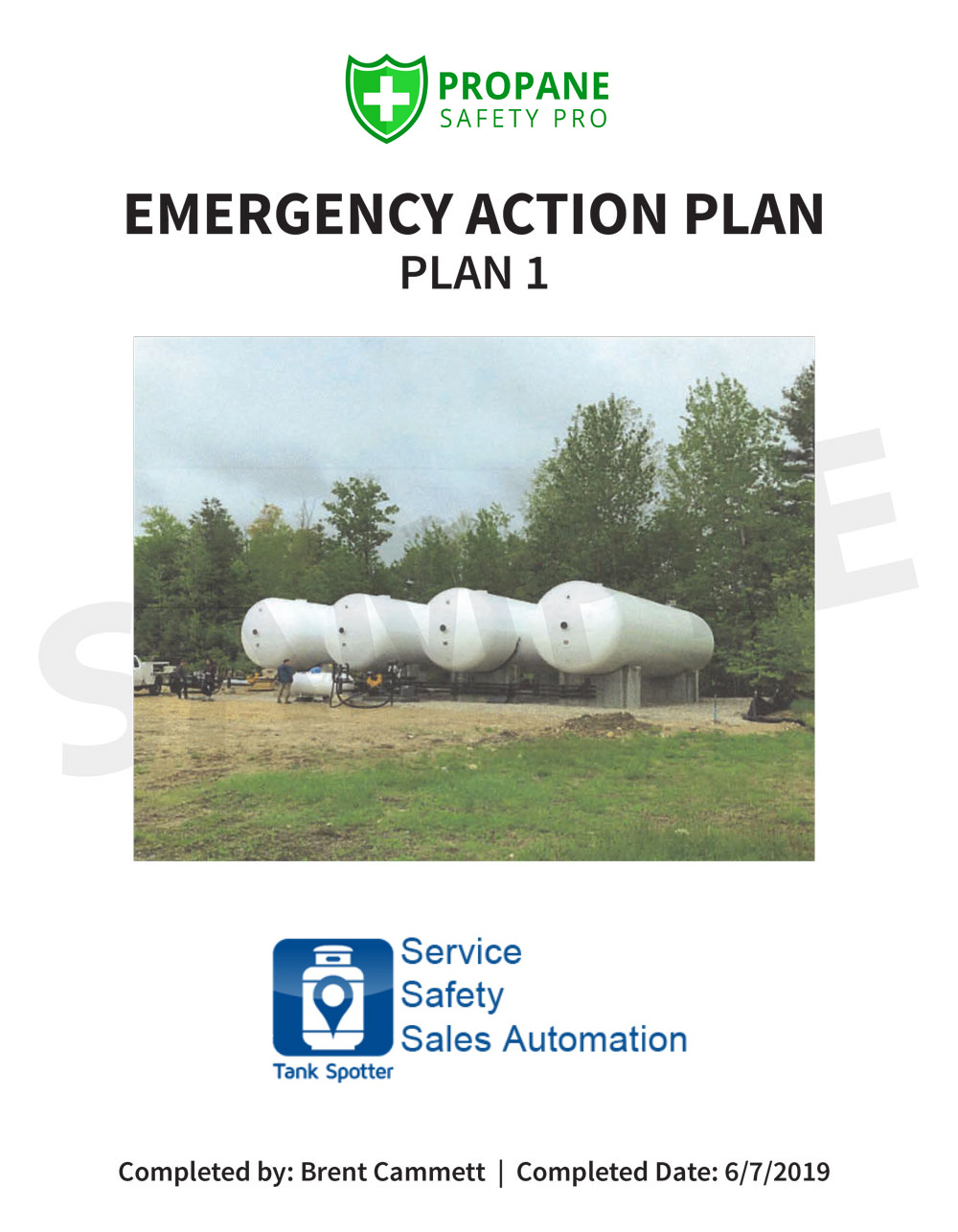
This week the inspector asks a propane bulk plant for the written emergency action plan. Next comes the last review with the yard crew. Then they ask who is named to call 911 if someone smells gas at the bulkhead. You need paper on hand, roles people know, and a head count that works when the alarm sounds.
A workplace copy that lacks the standard's required procedures leaves the yard with no file when an inspector or responder asks. That means reporting a fire or other emergency, evacuation and exit-route assignments, and accountability after evacuation. It also means the name or job title of who employees contact for more information about the plan.
What OSHA 1910.38 requires in writing
Under 29 CFR 1910.38, an employer must have an emergency action plan whenever a Part 1910 OSHA standard requires one. For a bulk plant, 29 CFR 1910.157 often triggers that duty. That happens when employees evacuate instead of fighting fires with portable extinguishers. The plan must be in writing, kept in the workplace, and available to employees for review. An employer with 10 or fewer employees may communicate the plan orally to employees.
At a minimum, the standard requires these elements:
- Procedures for reporting a fire or other emergency
- Procedures for emergency evacuation, including type of evacuation and exit route assignments
- Procedures to be followed by employees who remain to operate critical plant operations before they evacuate
- Procedures to account for all employees after evacuation
- Procedures to be followed by employees performing rescue or medical duties
- The name or job title of every employee who may be contacted by employees who need more information about the plan or an explanation of their duties under the plan
The same rule also requires an employee alarm system. That system must use a distinctive signal for each purpose and comply with 29 CFR 1910.165.
If your plant has more than 10 employees, keep a written emergency action plan. Do the same if an insurer or AHJ wants paper. Put it where the night shift can find it without calling the owner first.
Who calls whom when something goes wrong
Name the steps and the people in the emergency action plan.
OSHA's Evacuation Plans and Procedures eTool restates the reporting element. Preferred means include dialing 911, an internal emergency number, or pulling a manual fire alarm. Put the preferred method in the plan and train to it.
On evacuation, that page says employees need to know who may order an evacuation. They also need the conditions that trigger it, how to evacuate, and which routes to take. Exit diagrams are typically used to identify escape routes from each area. Name who may order evacuation at your yard. Name who stays only if the plan assigns critical plant operations before they leave. For accountability after evacuation, that page describes roll call at the assembly area. Many employers designate an evacuation warden to assist others and account for personnel.
For rescue and medical duties, most small organizations rely on the local fire department or hospital. The plan still needs procedures for anyone you assign those duties. The develop-and-implement page describes a common practice: select a coordinator for the emergency.
That person assesses whether an emergency exists and oversees the procedures. The role also notifies outside emergency services and directs shutdown of utilities or plant operations if necessary. When the fire department responds, that page states those officials assume responsibility for the safety of building occupants. The highest-ranking responder assumes incident command while working with the onsite coordinator.
At a bulk plant you are the retailer. When someone smells gas or sees fire at the plant, follow the plan's own reporting procedure. Contact the named emergency coordinator in the EAP. That coordinator assesses whether an emergency exists and notifies outside emergency services. The written plan assigns who reports, who accounts for people, and who talks to responders after people move to safety.
Training, review, and practice drills
The standard requires the employer to designate and train employees to assist in a safe and orderly evacuation of other employees. It also requires review of the plan with each covered employee at three points. Review when the plan is developed or the employee is assigned initially to a job. Review again when the employee's responsibilities under the plan change, and when the plan is changed.
The federal rule does not print a required drill calendar. The develop-and-implement page says effective plans often call for retraining employees annually and include drills. In those drills, employees practice evacuating their workplace and gathering in the assembly area.
The same page says it is a good idea to hold practice drills as often as necessary to keep employees prepared. Include outside resources such as fire and police departments when possible. After each drill, evaluate it and improve the plan.
Treat that guidance as how you prove training and review work. Keep a dated record of who was trained and who held the orderly-evacuation role. Note when you last walked the assembly area with the crew.
Pair the EAP with written policies and procedures. That way the shutdown steps people practice match how the plant actually runs.
How NFPA 58 emergency planning fits beside the EAP
The EAP is the people-out file under OSHA. LP-Gas fire-protection planning under NFPA 58 is the plant fire-risk file. Keep both as two documents in the same drawer. The Railroad Commission of Texas Fire Safety Analysis Manual quotes NFPA 58, 2017 Edition, §6.29. That section covers industrial plants, bulk plants, and dispensing systems with an aggregate water capacity greater than 4,000 gallons. As quoted there, planning shall be coordinated with local emergency response agencies. That planning covers response to an inadvertent release of LP-Gas, fire, or security breach. It shall include consideration of the safety of emergency personnel, workers, and the public.
The same Texas RRC manual, quoting NFPA 58 §6.29.4.4, states that emergency controls shall be conspicuously marked. The controls shall be located so as to be readily accessible in emergencies. It also quotes the portable extinguisher rule at §6.29.4.2 for each industrial plant, bulk plant, and distributing point. Provide at least one portable fire extinguisher with a minimum capacity of 18 lb (8.2 kg) of dry chemical.
North Carolina's LP-Gas Section states that new and existing LP-Gas bulk plants must have fire safety analysis documentation. That documentation follows NFPA 58. Its alternative method centers on a documented meeting with local fire officials. That meeting covers emergency access, emergency shutdown controls, and emergency contact names and telephone numbers.
Confirm the edition and paperwork your state and AHJ actually adopt. Keep the EAP contact list and the NFPA-driven responder coordination together.
What your plant manager does this week
Have your plant manager pull the written emergency action plan from the workplace copy this week. Check that all six required elements are filled in, including the named contact titles. Confirm the distinctive alarm and assembly area match what the yard uses.
Then schedule a plan review with every covered employee who has not had one since the last assignment or plan change. Before Friday, that same manager walks the assembly area with the designated evacuation helpers. Write the date of the walk-through on the training record.
Common questions
Does a small propane plant need a written emergency action plan?
When an OSHA standard requires an EAP, 29 CFR 1910.38 says it must be in writing, kept in the workplace, and available to employees. An employer with 10 or fewer employees may communicate the plan orally. Many plants keep it in writing anyway because insurers and the AHJ ask for paper.
How often should the plan be reviewed with employees?
The standard requires a review when the plan is developed or an employee is first assigned, when an employee's duties under the plan change, and when the plan changes. OSHA's eTool adds that many employers retrain annually and run drills.
Is the emergency action plan the same as the NFPA 58 fire safety analysis?
No. The EAP covers getting people out and accounted for under OSHA. The fire safety analysis and responder coordination come from NFPA 58 as your state adopted it. Keep both, side by side.
Sources
- National Archives / eCFR, 29 CFR 1910.38 Emergency action plans, as of September 25, 2026 (text cites 67 FR 67961, Nov. 7, 2002; eCFR CAPTCHA-blocked automated fetch — verified via GovInfo CFR-2025-title29-vol5-sec1910-38.xml, dated 2025-07-01, and OSHA.gov 1910.38 mirror) — www.ecfr.gov
- Occupational Safety and Health Administration, 1910.38 - Emergency action plans, as of September 25, 2026 — www.osha.gov
- Occupational Safety and Health Administration, 1910.157 - Portable fire extinguishers, as of September 25, 2026 — www.osha.gov
- Occupational Safety and Health Administration, eTool: Evacuation Plans and Procedures - Emergency Action Plan - Minimum Requirements, as of September 25, 2026 — www.osha.gov
- Occupational Safety and Health Administration, eTool: Evacuation Plans and Procedures - Develop & Implement an Emergency Action Plan (EAP), as of September 25, 2026 — www.osha.gov
- Railroad Commission of Texas, Fire Safety Analysis Manual for LP-Gas Storage Facilities (quotes NFPA 58, 2017 Edition, §6.29), cover date October 2022 (PDF CreationDate Dec. 16, 2022; verified September 25, 2026) — www.rrc.texas.gov
- North Carolina Department of Agriculture & Consumer Services, Standards Division, LP-Gas Section, Fire Safety Analysis, as of September 25, 2026 — www.ncagr.gov
This page is general information for propane marketers in the United States. It is not legal advice and it does not certify compliance. Confirm the current rule text, your state's adopted code, and your insurer's requirements before you rely on any example here.
Propane Safety Pro writes the written programs linked above, built to how your company actually runs. Call 610-228-0887 and ask for the written program. We sell to propane companies, not homeowners.