
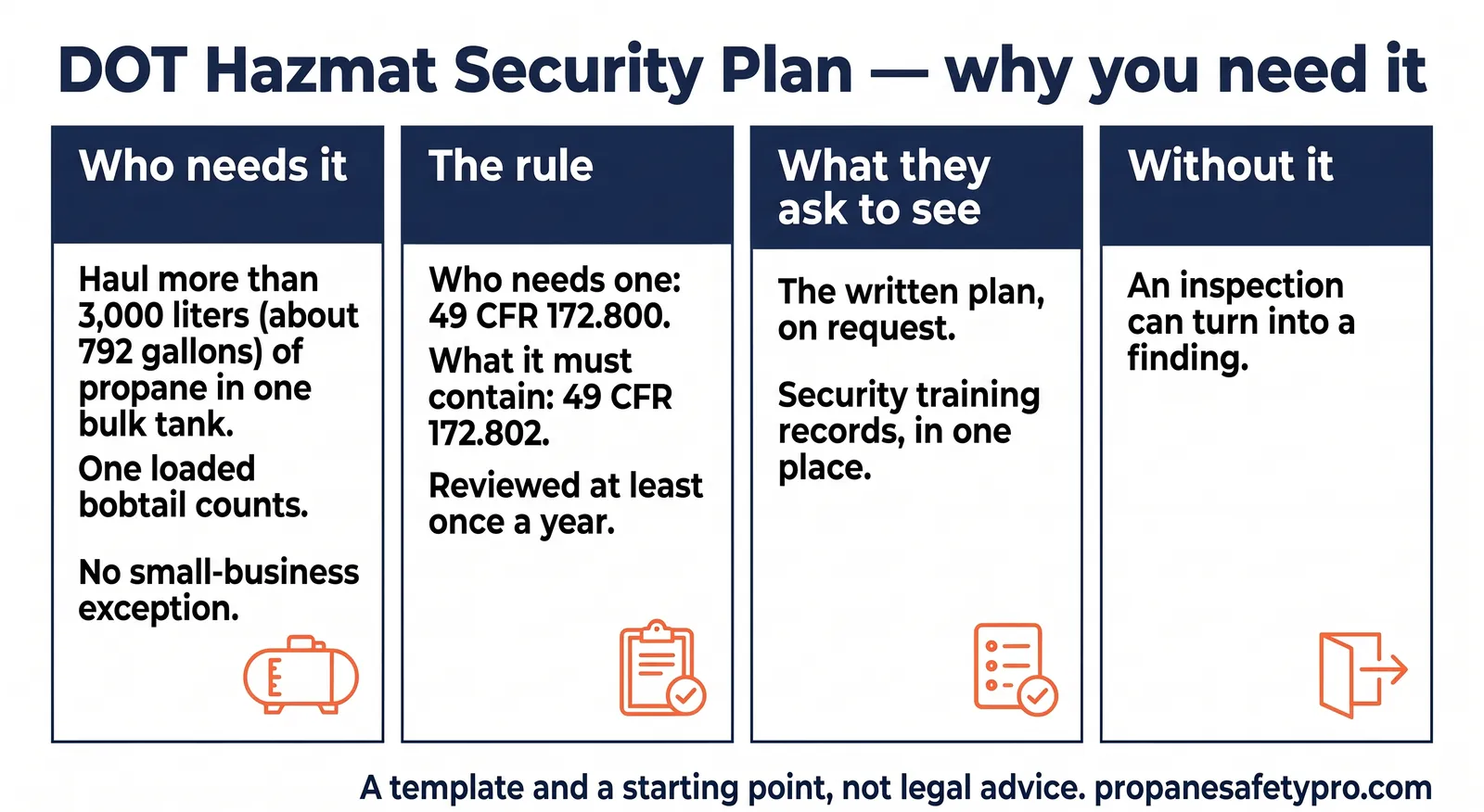
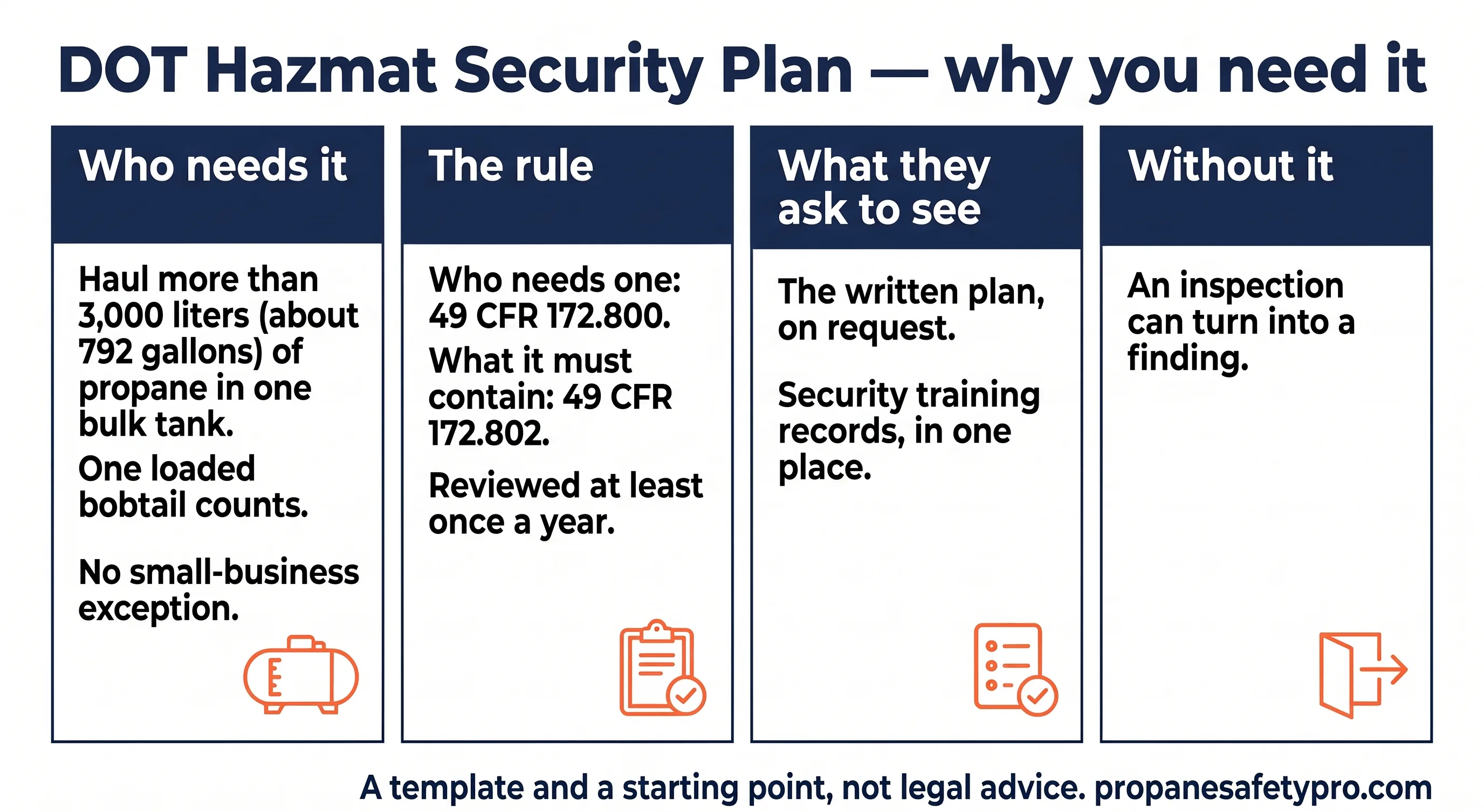
A DOT hazmat security plan is your written plan for keeping hazmat safe from theft and misuse. It covers your risks, hiring checks, who can reach the trucks, and security on the road. You need one if you ship or haul more than 792 gallons (3,000 liters) of propane in one tank. Review it at least once a year.
A loaded bobtail or transport clears that 792-gallon line. The plan must be in writing, fit your own company, and be updated when your operation changes.
There is no small-business exception. One truck counts the same as a fleet.
PHMSA's HM-268 rules took effect Sept. 3. The rule isn't new, but this fall's yearly review is the moment to check your plan.
Get your DOT Hazmat Security Plan One form, about an hour. Or call 610-228-0887 and ask for Bill.

About an hour on one form, no site visit. We write the plan around your trucks, cited section by section.
Get your DOT Hazmat Security Plan
Listen in the truck: six written plans, under 10 minutes. For each one: who needs it, the rule behind it by section, and what it costs you to go without.
The security plan starts at 2:19. "Do small mom and pop shops really need this?" is at 2:26.
The annual review is the part that slips
Plenty of propane companies wrote a security plan once. Fewer can show the last date anyone read it.
The rule says the plan must be reviewed at least once a year and revised as your operation changes. Think new drivers, a new truck, a moved plant, a new product, or a new security manager. Each of those can make a plan out of date before the year is up.
Keep a review log in the front of the binder. Date it, sign it, and write what changed. If nothing changed, write "No changes" and sign it anyway. That one page shows the plan is kept current.
Already have a plan? Send it to us. We will tell you what is stale and whether it needs a refresh or a rewrite.
Who needs a DOT hazmat security plan
The federal test is simple. You need a written plan if you offer for transport, or transport, a "large bulk quantity" of a Division 2.1 flammable gas. Propane is Division 2.1 (UN1075). DOT sets large bulk at more than 3,000 liters, which is 792 gallons, in a single packaging such as a cargo tank.
| Your operation | Plan required? |
|---|---|
| You run a bobtail or a transport | Yes. A loaded cargo tank holds far more than 792 gallons. |
| No single tank or container you ship or haul ever holds more than 792 gallons of propane | Likely not. Check anyway, because other materials you haul can trigger it on their own. |
| Cylinder delivery only, nothing over 792 gallons in one container | Likely not. Same check applies. |
Company size does not change the answer. Three trucks or thirty, the rule is the same. If you are cylinder-only and small, call us. We would rather tell you "you do not need this" than sell you a book.
What a hazmat security plan must contain
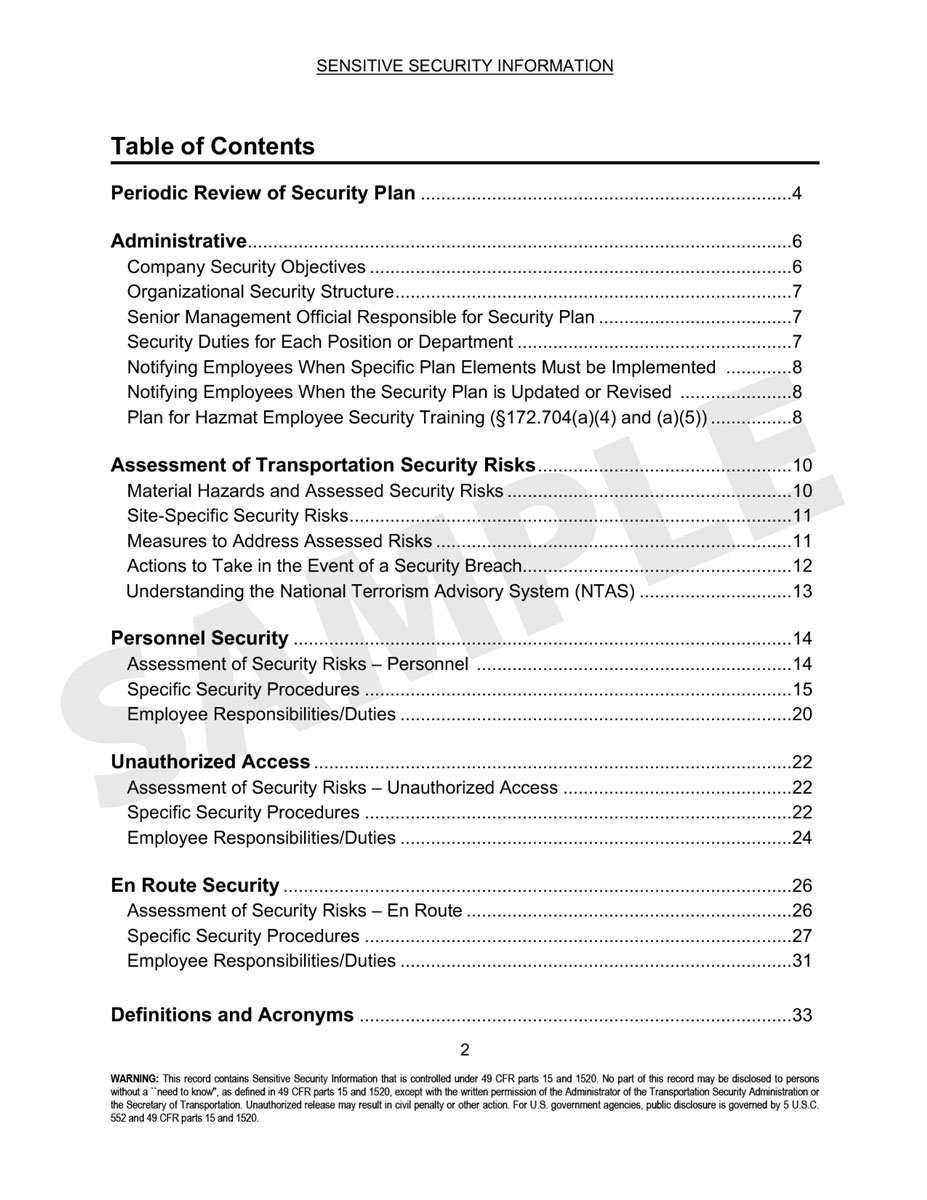
Under 49 CFR 172.802, the plan starts with a written look at your security risks. That includes risks at your own yard or plant, where propane is loaded, stored or unloaded. Then it has to cover three areas:
 Personnel security. How you check the information job applicants give you before they get access to trucks or product.
- Unauthorized access. Who can reach the trucks, the keys and the bulk storage, and how you keep everyone else out.
- En route security. How the load stays secure between your plant and the customer's tank, including stops along the way.
The plan also has to name, by job title, the senior manager responsible for it. It has to spell out security duties for each job that carries them out. And it needs a plan for training your hazmat employees.
Keep it in writing for as long as it is in effect. Keep a copy at your main place of business. Make it available to the employees who carry it out. Show it to DOT or Homeland Security officials when they ask.
The training that goes with the plan
Your drivers already carry general hazmat training. The security plan adds two layers under 49 CFR 172.704:
 Security awareness training for every hazmat employee.
- In-depth security training for those same employees, because your company has a plan. It teaches them the plan itself and their part in it.
New hires and people who change jobs get it within 90 days. After that, repeat it at least every three years, and keep the records.
We do not teach classes on site. We write the training pages into your plan, and when you need a class, we connect you with a training partner.
How we build your plan
- You get one intake form. Your plant, your trucks, your keys and gates, your hiring steps, your routes.
- You spend about an hour on it. Owner or safety manager. No site visit, no meetings.
- We write the plan to your operation. Your yard, your trucks, your roles. Built within a week of your completed form.
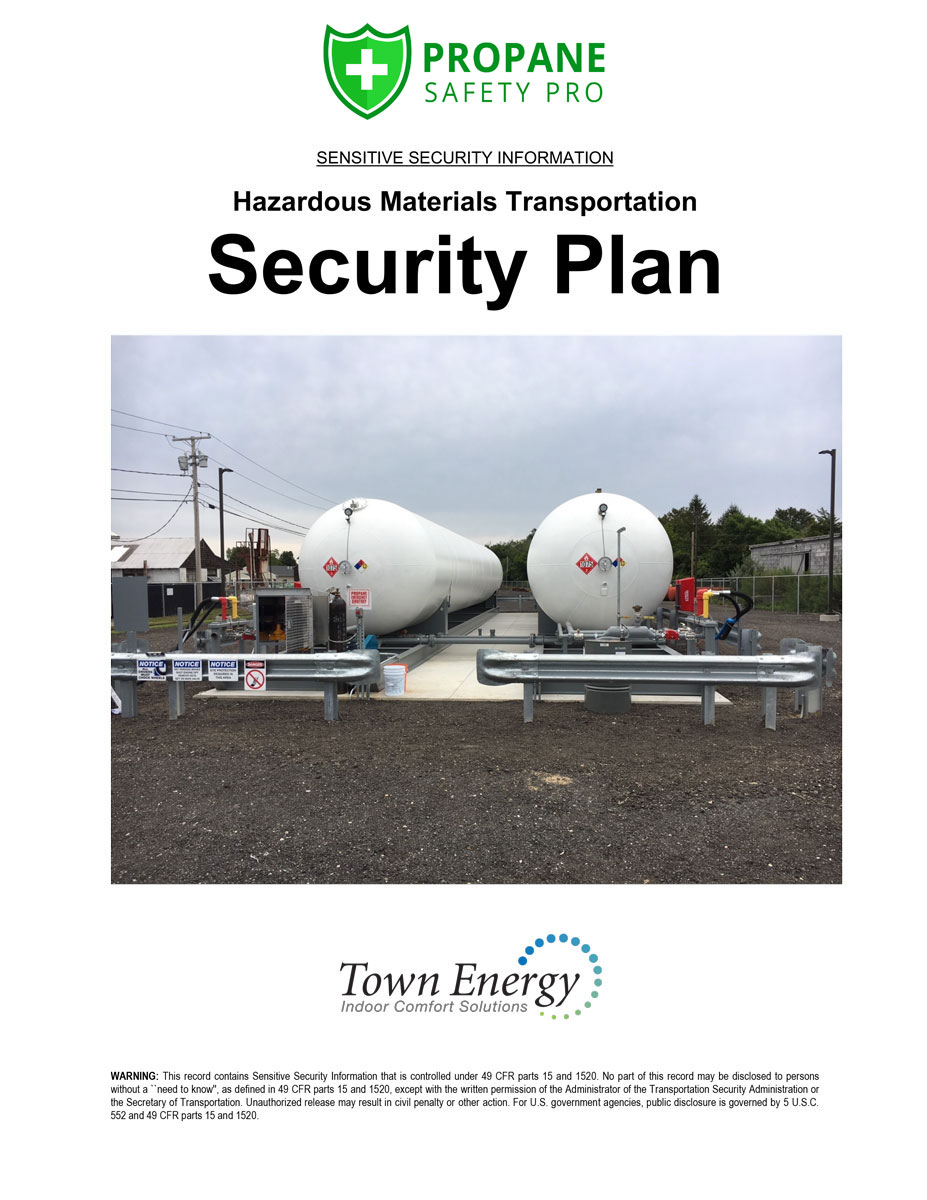
- You get a print-ready plan with the review log and the training record pages, ready for a DOT investigator or an insurance auditor.
If you also haul heating oil, diesel or gasoline, tell us on the form and we write those loads into the same plan.
One form. About an hour. That is your whole side of it.
Ask for the intake form Or call 610-228-0887
Pair it with your Policies & Procedures manual
We build the security plan and the Policies & Procedures manual from the same intake form. Your driver's day is already regulated end to end: the pre-trip, the placards, the emergency response information on board, the leak check after an interruption of service. The two books say, in writing, that your company runs it that way.
Running a bulk plant? Add the Operations & Maintenance manual. OSHA paperwork next on the list? Add the SDS / HazCom binder.
Questions owners ask
How often must a DOT hazmat security plan be reviewed?
At least once a year. It must also be revised or updated whenever your operation changes. Log each review with the date, what changed and who signed it. Write "No changes" when nothing changed.
Who needs a DOT hazmat security plan?
Anyone who offers for transport or transports more than 3,000 liters (792 gallons) of propane in a single packaging, such as a cargo tank. The rule is 49 CFR 172.800(b)(3). Other hazmat you haul can trigger a plan too.
Does a propane bobtail need a security plan?
Yes. A loaded bobtail holds far more than 792 gallons of propane in one cargo tank. That puts the company that runs it inside the rule.
Is there a small business exception?
No. The only exception in the rule is a narrow one for some farmers hauling for their own farm. It does not cover a propane retailer of any size.
What must a hazmat security plan include?
A written risk assessment, including your own yard or plant. Then personnel security, unauthorized access and en route security. It must also name the responsible senior manager by job title, list security duties by job, and include a training plan.
What security training do my employees need?
Every hazmat employee needs security awareness training. Because your company has a plan, they also need in-depth training on the plan itself. Give it within 90 days of hire or a job change, repeat it at least every three years, and keep records.
Where do I keep the plan?
In writing, for as long as it is in effect. Keep a copy at your main place of business, where the employees who carry it out can get to it. Show it to DOT or Homeland Security officials when they ask.
Can I use a hazmat security plan template?
A template can help you start. The rule asks for your own risks, your own yard and your own people, so every blank has to be filled with what you really do. Never list a lock or camera you have not installed.
What will an inspector ask for?
The rule lets DOT ask to see the plan, and your training records must be ready on request too. Have the plan, the last review date, the manager named by job title, and your drivers' training records in one place. If you cannot find those dates, that is the call to make.
How much time does it take, and what does it cost?
About an hour of your time on one form. The plan is built within a week of your completed form. Price depends on your operation and how many documents you need, so call and we will tell you straight.
Who builds it
Bill Stomp ran 87 branch offices across 12 states over a 25-year operator career, combat veteran. He's since helped 200+ propane companies.
He ran propane operations himself. He has signed the payroll, worked the winter, and stood in the room when a state inspector asked for paper nobody could find.
Insurance professionals at Aegis, Nationwide, and eMaxx Assurance Group have recommended Propane Safety Pro to propane operators they work with.
Three trucks or thirty, the file has to hold up the same way.
Ask for the intake form Or call 610-228-0887
Related
- What is a DOT hazmat security plan? The plain-English explainer.
- Policies & Procedures manual
- Operations & Maintenance manuals
- CETP training: we connect your crew with a training partner.
- SDS / HazCom binder
- Do I need a DOT hazmat security plan?
- What an auditor asks for
- What does a DOT audit ask for?
- Ask for redacted sample pages
- Every Propane Safety Pro manual in one place on Propane Insider
- Keep training dates and renewal reminders on the phone with Tank Spotter
This page explains the federal rule in plain words. It is not legal advice. Your state may add its own rules, so confirm with your state propane association or your own advisor.
Propane Safety Pro · Digital Software Services, LLC · 112 Holby Lane, Pottstown, PA 19465