The book on the shelf should match the work your crew does today. New equipment, a changed procedure or a different site can leave an old copy behind. Current procedures can help with inspections, insurer reviews and showing a new hire how your shop works.
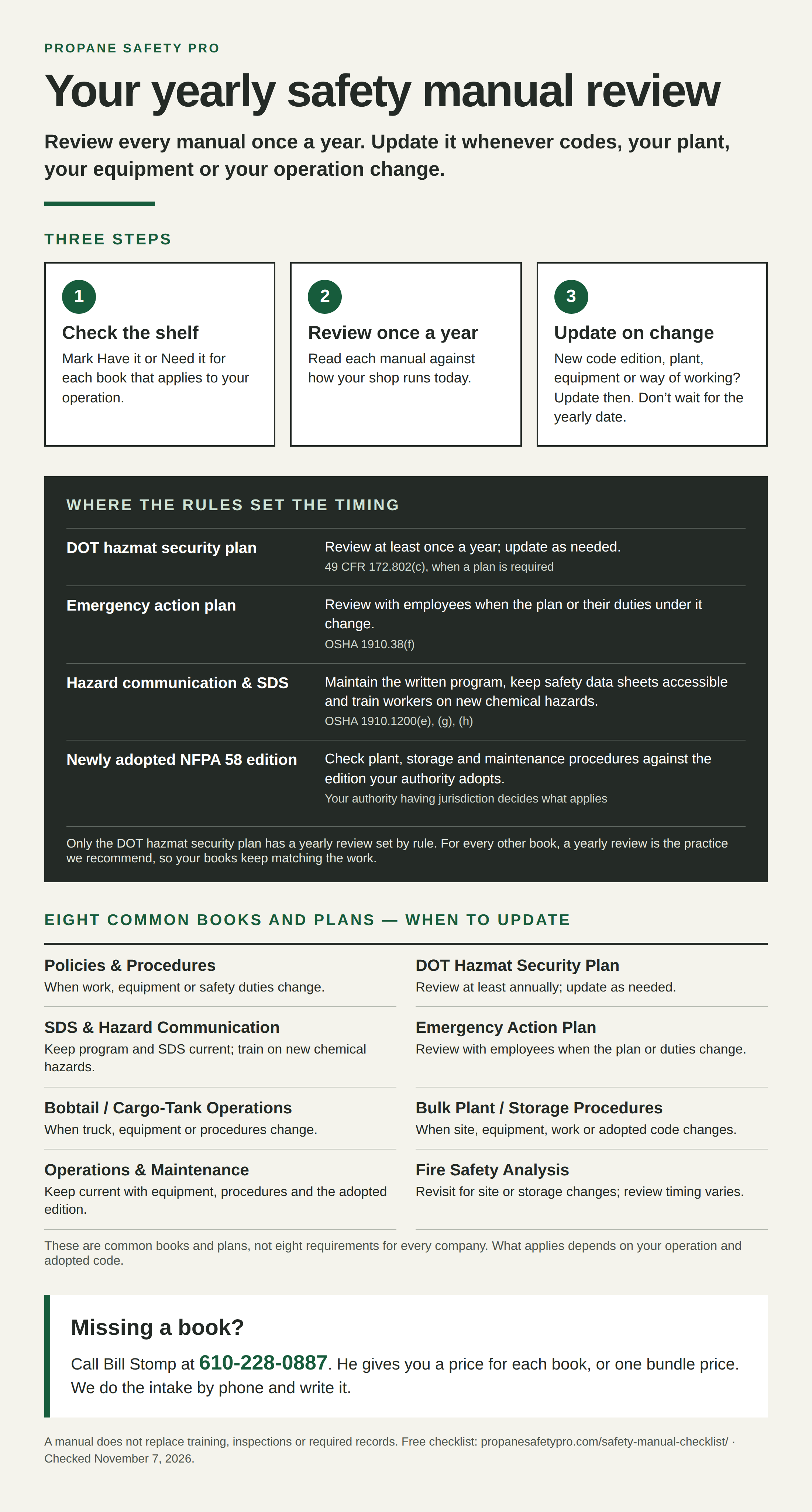
Review every manual once a year. Update it whenever things change.
Set one date a year to read every manual against how your shop runs today. When codes, your plant, your equipment or your operation change, update the manual then. Don’t wait for the yearly date.
Some of this timing is set by rule:
A required DOT hazmat security plan must be reviewed at least once a year and updated as needed (49 CFR 172.802(c)).
A required emergency action plan must be reviewed with employees when the plan changes or their duties under it change (OSHA 1910.38(f)).
A written hazard communication program must be maintained, safety data sheets kept accessible, and workers trained when a new chemical hazard comes into their work area (OSHA 1910.1200(e), (g), (h)).
When your state or local authority adopts a newer NFPA 58 edition, check your plant, storage and maintenance procedures against it. Your authority having jurisdiction decides what applies.
Only the DOT hazmat security plan has a yearly review set by rule. For every other book, a yearly review is the practice we recommend, so your books keep matching the work.
A book does not do the training for you. Keep required training, inspections and records current too.
See it at a glance
The yearly review on one page.
Three steps, the rules that set review timing, and when to update each of the eight common books. Save it or share it with whoever keeps your binders.
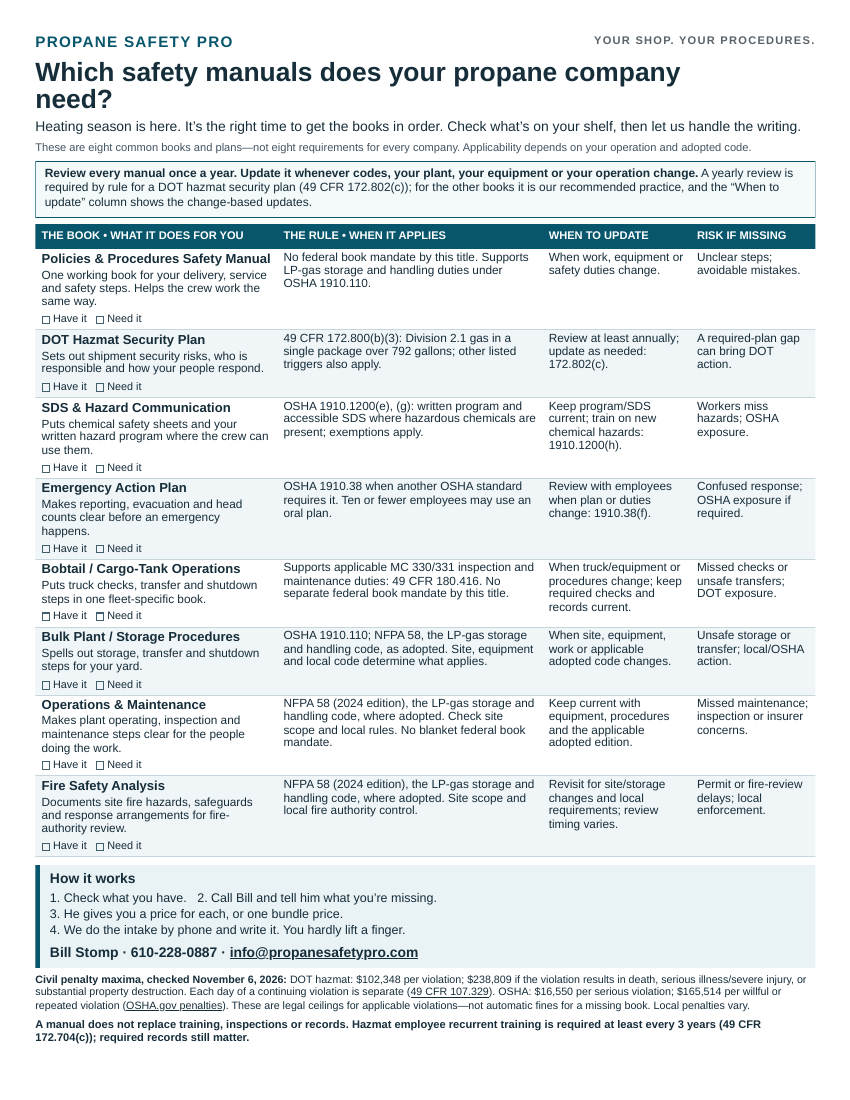
Documents site fire hazards, safeguards and response arrangements for fire-authority review.
Rule & when it applies
NFPA 58 (2024 edition), the LP-gas storage and handling code, where adopted. Site scope and local fire authority control.
When to update
Revisit for site/storage changes and local requirements; review timing varies.
If missing
Permit or fire-review delays; local enforcement.
Rules and review timing follow the cleared checklist, checked November 6, 2026. See the source notes. Your authority having jurisdiction (AHJ) determines local adopted-code requirements.
Start one intake for all the books you need. Bill gives you a price for each, or one bundle price. We do the intake by phone and write the books around how your yard runs.
Policies & Procedures and the DOT Hazmat Security Plan are books we deliver to clients today. The other six start from our templates, and we fill them in from your intake.
Unclear procedures can mean missed checks, an uncertain emergency response or delays in a fire-authority review. What is legally required depends on your work and the applicable rule.
These figures are legal ceilings for applicable violations—not automatic fines for a missing book. Several manual titles above have no separate federal book mandate. Local penalties vary.
Current civil penalty maximums
OSHA: $16,550 per serious violation; $165,514 per willful or repeated violation. OSHA penalty table.
DOT hazmat: $102,348 per violation; $238,809 if the violation results in death, serious illness, severe injury or substantial property destruction. Each day of a continuing violation is separate. 49 CFR 107.329(a).
Checked November 6, 2026.
When someone asks for the records
Give your insurer something clear to review.
Insurers and loss-control reviewers may ask to see written safety programs, procedures, training and inspection records. The document list varies by carrier and program. Ask your agent for the current list.
For example, National Interstate’s LP operations application requests a written safety program and contents pages for manuals you hold. Other insurers often ask whether you have written procedures.
A manual is one part of that picture. It does not guarantee coverage, a lower premium or an inspection result.
If you find a gap
Easy to order. Easy to fill out. Easy to understand.
Check what you have.Use the inventory above or the printable sheet.
Call Bill or send the form with what you’re missing.You don’t need to sort out every rule before you ask.
He gives you a price for each, or one bundle price.Choose the books you need for your operation.
We do the intake by phone and write it.You hardly lift a finger.
Put the procedures to work
Your manuals set the rules. The Propane Safety App helps your team follow them.
A manual sets the rules; it doesn’t do the training, inspections or record-keeping by itself. That’s what the Safety App is for.
The Propane Safety App helps with training records, inspection checklists and reminders, and finding field records when an inspector or your insurer asks. Review the records for gaps; the app does not by itself prove compliance or that every required task was done.
Want a price on the books you’re missing? Send the form. Your Need it choices travel with your request, and the PDF is there to download again after you send it.
A preview of the actual PDF you’ll download.
Before you check the shelf
Questions owners ask.
Does every propane company need all eight manuals?
No. These are eight common books and plans, not eight requirements for every company. What applies depends on your work, equipment, site, employee count and adopted rules. Check the rule beside each item, then confirm your scope with your authority having jurisdiction or qualified adviser.
Is an annual safety manual audit always required?
Not for every book. A required DOT hazmat security plan must be reviewed at least once a year (49 CFR 172.802(c)). No rule sets a yearly date for the other books. Where a rule does speak to timing, it ties the update to a change, such as a changed emergency plan or duties, a new chemical hazard, or a newly adopted code. Our advice is the same for every book: review it at least once a year, and update it whenever codes, your plant, your equipment or your operation change.
Will a missing manual automatically bring a fine?
No. The listed OSHA and DOT figures are legal maximums for applicable violations, not automatic fines for a missing book. Some of these manual titles have no separate federal book mandate. The rule, facts and enforcing authority matter.
Will a manual meet every insurer requirement?
No. Carrier and program requirements vary. Ask your insurance agent for the current document list. Written procedures may be part of a review, alongside training, inspections and records. A manual alone does not guarantee coverage or a premium change.
What happens after I fill out the checklist form?
After a successful submission, you can download the PDF on the page. Without JavaScript, the thank-you page has the same download link. Your Need it choices and any Safety App request go with your inquiry. The form does not automatically email the PDF or enroll you in the app.
Can Bill help with the books I am missing?
Yes. Call Bill at 610-228-0887 or send the form with what you need. He gives you a price for each manual or one bundle price. We do the intake by phone and write it. Hands-on training and certification stay with outside trainers.
Sources & review notes
Checklist and penalty figures checked ; review-timing guidance rechecked . Prepared by Propane Safety Pro. This inventory helps you organize a review; confirm the rules that apply to your operation.
NFPA 58, Liquefied Petroleum Gas Code (2024 edition): NFPA’s code for LP-gas storage, handling, transportation and use. Only where adopted and applicable. Your local fire authority and site scope decide which parts apply.
Start with the shelf. We’ll help with the writing.