
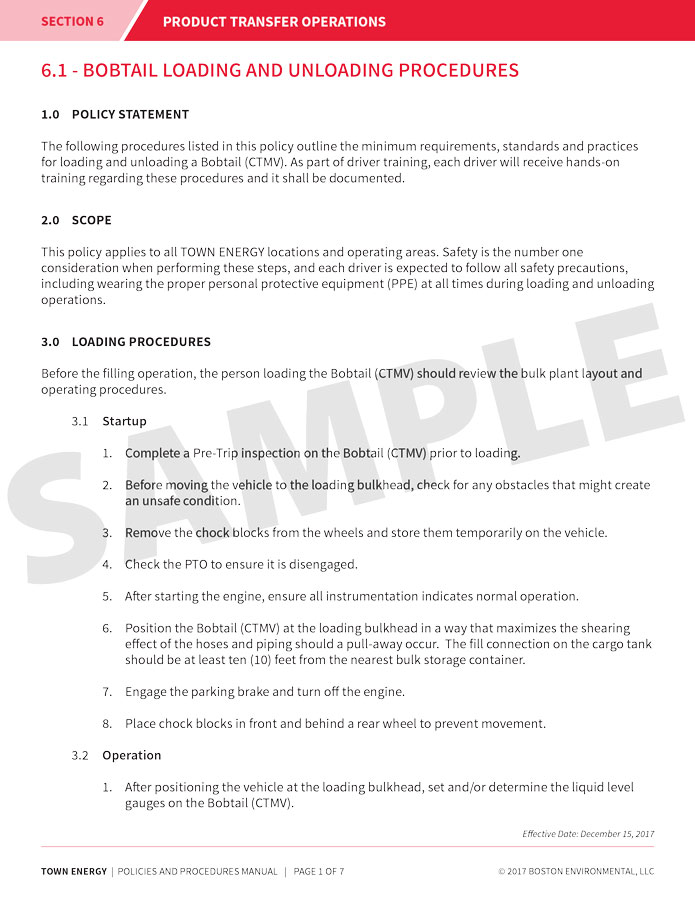
When an insurer's loss-control visit or the authority having jurisdiction walks your yard this week, they ask for written procedures. Those procedures must match how the trucks and plant actually run. Your safety lead needs one book the owner, the insurer, and a new hire can open on night one. That book is the propane policies and procedures manual. It holds the written chapters drivers follow on the truck and the CSR follows on the phone.
A missing attendant rule, leak script, or 172.704 training record stops a fill. It fails a visit. It leaves the owner with no file when counsel asks. Soft language in a binder that nobody opens does not help.
Delivery procedures that match the truck
Write the bobtail pre-trip, placarding checks, fill steps, and what the driver does when a tank, meter, or hose looks wrong. OSHA's 29 CFR 1910.110 requires that at least one attendant remain close to the transfer connection. That duty runs from the time connections are first made until they are finally disconnected during product transfer. Put that attendant rule in plain words in the delivery section so a new driver does not treat it as optional.
NFPA 58 is the industry benchmark for safe LP-Gas storage, handling, transportation, and use. NFPA 58 organizes transfer work in Chapter 7 and vehicular transportation in Chapter 9. Your delivery chapter should point to the edition your state actually adopted. Keep the section short enough that a driver can open it before the first stop.
Leak calls and out-of-gas work
A gas-smell call belongs on the phone script and the dispatch board before anyone opens a ticket. Dealer guidance for any gas smell: leave the area first. Then call the propane retailer, or call 911 if you cannot reach them. Fire or carbon monoxide means call 911 first. Your manual should spell the CSR script and the dispatch order. Name who is allowed on site. Say when the truck rolls and when it stays put.
Out-of-gas calls need their own steps. Spell how you confirm the tank is empty. Name who authorizes a return to service. Say what the driver documents before leaving the site. NFPA 58 includes Annex L on suggested methods of checking for leakage. Your written leak-check steps should match how your techs actually work. A generic paragraph copied from an old binder does not do that.
Cylinder filling and plant transfer
Cylinder and plant fill work sits under both NFPA 58 transfer rules and OSHA 1910.110. OSHA says personnel performing installation, removal, operation, and maintenance work shall be properly trained in such function. Put the fill checklist, who is authorized to fill, and the stop conditions in writing.
OSHA also requires that readily ignitible material such as weeds and long dry grass be removed within 10 feet of any container. That plant housekeeping rule belongs in the same chapter as the fill steps. Then the plant lead and the filler see one standard. If you exchange or store cylinders awaiting use, keep those storage rules next to the fill rules. A new hire should find them fast.
Training records DOT actually asks for
49 CFR 172.704 says hazmat employee training must cover general awareness, function-specific work, safety training, and security awareness training. New hazmat employees must receive the security awareness training within 90 days after employment. A new hazmat employee, or one who changes job functions, may work under direct supervision. That supervisor must be a properly trained and knowledgeable hazmat employee. Training must still be completed within 90 days. Recurrent training is required at least once every three years.
The hazmat employer must create and retain a record of current training for each hazmat employee. Keep it for as long as that person is employed as a hazmat employee and for 90 days thereafter. The record must include the employee's name and the most recent training completion date. It must also include a description, copy, or location of the training materials. Add the name and address of the person who provided the training, and certification that the employee has been trained and tested.
Your manual's training chapter should name who owns that file and where it lives. It should also say how a supervisor proves a driver was trained before the next audit. Where security awareness training appears, keep a matching written DOT security plan next to those dates. The office can then show both in one pull.
Emergency plan the crew can find
When an OSHA standard requires an emergency action plan, 29 CFR 1910.38 applies. The plan must be in writing, kept in the workplace, and available to employees for review. An employer with 10 or fewer employees may communicate the plan orally. At a minimum the plan must cover how to report a fire or other emergency. It must also cover evacuation procedures and exit routes, and who stays for critical operations. Cover how you account for employees after evacuation. Cover rescue or medical duties, and the name or job title of people who can explain the plan.
Review it with each covered employee when the plan is developed or the person is first assigned. Review it again when duties under the plan change, and when the plan itself changes. Put the call list and plant map in the same place every new hire is shown on day one.
Safety policy, service work, and recordkeeping
Open the book with the company safety policy and who owns it, by name and title. Give service and installation work its own procedures, apart from delivery. Close with recordkeeping: what you keep, where it lives, and how long you hold it.
Who reads the book after you write it
Three people read this book. The owner needs one place that matches how the company really runs. The insurer's loss-control visit asks for written procedures. Tribal knowledge will not pass that visit. The new hire needs a chapter they can open without calling three people.
Have your safety lead pull the bobtail pre-trip page and the 172.704 file the same afternoon. Mark every step that still lives only in someone's head.
Use a written policies and procedures manual that mirrors how you run delivery, leaks, fills, training, and emergencies. That book gives those three readers the same story. Pair the training chapter with driver training records paperwork. Use that pair when DOT asks for proof. This week, have your safety lead open the training file. Confirm every active hazmat employee has a 172.704 record with a completion date inside the three-year window.
Common questions
Does a propane company need a written policies and procedures manual?
Owners keep a written book because insurers, the authority having jurisdiction, and counsel ask for procedures that match how the trucks and plant actually run. A verbal habit does not give a new hire or an auditor the same steps. Build the sections your drivers and CSR use every week, then keep the training and emergency chapters with them.
What training record does DOT require under 49 CFR 172.704?
The hazmat employer keeps each hazmat employee's current training record while that person is a hazmat employee and for 90 days afterward. The file has to prove the person was trained and tested on the schedule 172.704 sets. The record lists the employee's name, the latest completion date, the training materials, the trainer's name and address, and a certification that the employee was trained and tested.
What must an OSHA emergency action plan include?
When OSHA requires a plan, it must cover reporting emergencies, evacuation and exit routes, critical operations before evacuation, accounting for employees after evacuation, rescue or medical duties, and who employees can contact about the plan. Employers with more than 10 employees must keep it in writing at the workplace.
Sources
- NFPA, NFPA 58 Code Development (Liquefied Petroleum Gas Code), Current Edition 2024 — www.nfpa.org
- OSHA / eCFR, 29 CFR 1910.110 Storage and handling of liquefied petroleum gases, eCFR current — www.ecfr.gov
- PHMSA / eCFR, 49 CFR 172.704 Training requirements, eCFR current — www.ecfr.gov
- OSHA / eCFR, 29 CFR 1910.38 Emergency action plans, eCFR current — www.ecfr.gov
- UpCodes, Liquefied Petroleum Gas Code (NFPA 58, 2024) chapter outline incl. Annex L, 2024 edition outline — up.codes
This page is general information for propane marketers in the United States. It is not legal advice and it does not certify compliance. Confirm the current rule text, your state's adopted code, and your insurer's requirements before you rely on any example here.
Propane Safety Pro writes the written programs linked above, built to how your company actually runs. Call 610-228-0887 and ask for the written program. We sell to propane companies, not homeowners.