
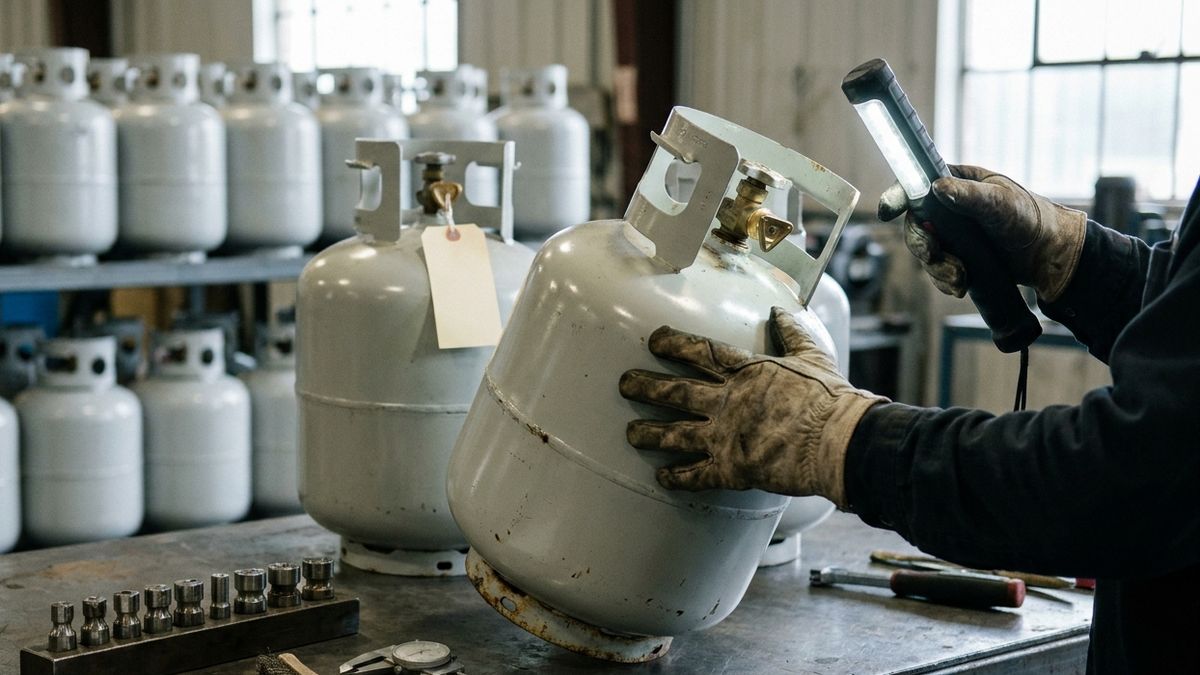
Any shop with an approved requalifier can put a fresh stamp on a cylinder. That part is routine. The harder question lands eight months later, when an adjuster or a state inspector asks to see the visual inspection that stamp was supposed to represent — and the clock starts running while someone digs through a filing cabinet.
We built Propane Safety Pro for the operators who feel that question coming. If you reached compliance through the safety door — as a compliance manager or an ops lead who would rather close the gap than explain it — this one is written for you.
The stamp is the last step, not the whole step
Under 49 CFR 180.205, DOT cylinder requalification runs in a fixed order. An approved requalifier completes and passes a visual inspection of the shell, base, and valve — checking for corrosion, dents, gouges, and leaks — and that inspection gets recorded. Then comes the date. A cylinder wearing a fresh stamp with no documented inspection behind it isn't requalified. It's a stamp with nothing under it, and it's out of compliance the day it leaves the rack, even if it looks perfect.
Some shops say "recert" instead of "requalification." DOT's rules govern the step either way. NFPA 58 covers storage and handling, OSHA 29 CFR 1910.110 covers the workplace, and neither one replaces the DOT requal requirement.
One yard, several clocks
The requal interval isn't the same for every bottle. Under 49 CFR 180.209, the period turns on cylinder type and method — 5, 7, 10, or 12 years. The 7-year option for 4-series cylinders arrived under the 89 FR 15667 amendment. Treat the whole yard as a single window and eventually a bottle gets stamped on the wrong schedule. That's an easy mistake to make and a hard one to explain after the fact.
Retrievability is the test DOT won't bend on
You can keep requal records on paper or digitally — your call. What DOT will not accept is "I can't find it." A completed cylinder is worthless as a compliance record if nobody can locate the shell check, the date, the requalifier's mark, and the outcome six months later. The shops that walk out of an audit clean aren't the ones with the tidiest racks. They're the ones who can put their hands on that file while the inspector is still standing there.
Here's where a gap turns costly. One incomplete requal file rarely draws a fine on its own. It becomes a liability the day something goes wrong and an adjuster or an attorney asks for the record behind the stamp. Rebuilding a paper trail after the fact — or admitting it never existed — is what turns a routine claim into a contested one. And retrievable records are becoming an underwriting question, not a nicety. Expect your carrier to ask how fast you can produce one.
That question is exactly what Propane Safety Pro answers. As the safety pillar of TankSpotter Field Worker OS — and still available as a safety-only deployment — it captures digital, timestamped inspection records for plant, above-ground, and underground tanks, plus cylinder requalification documentation, the moment the work happens. The file exists before anyone asks for it, not the week they do.
What an operator does Monday morning
You don't need new software to start closing the gap. Start here:
1. Pull five random cylinder files from last quarter. Confirm each has a documented visual inspection tied to the stamp — not just a logged date. 2. Check every cylinder type in your yard against the correct requal period under 49 CFR 180.209. Don't assume one window covers all of them. 3. Post a five-step requal routine at every workstation: verify the date against the stamp, inspect shell/base/valve, check for leaks, record the result, file it where anyone can pull it. 4. Run a mock audit this week. Hand a random file to someone outside your safety team and time how long it takes them to find the inspection record.
That last step is the tell. If it takes minutes today, you already know where the work is. We first reported this from the newsroom side in our coverage of cylinder recert liability; here we're looking at it from inside the shop.
If an inspector asked for your last five requalification records right now, how long would it take to put them on the desk? Request a demo of Propane Safety Pro and see how shops make that answer "minutes."
First published in Propane Insider.